

TokenPost.ai
Ethereum (ETH) saw a sharp short-term capital outflow of roughly $47.27 million, while the broader market¡¯s×ʽð appeared to rotate toward 'stablecoin liquidity'¡ªparticularly Tether (USDT)¡ªand into U.S. dollars, underscoring a more defensive positioning by traders.
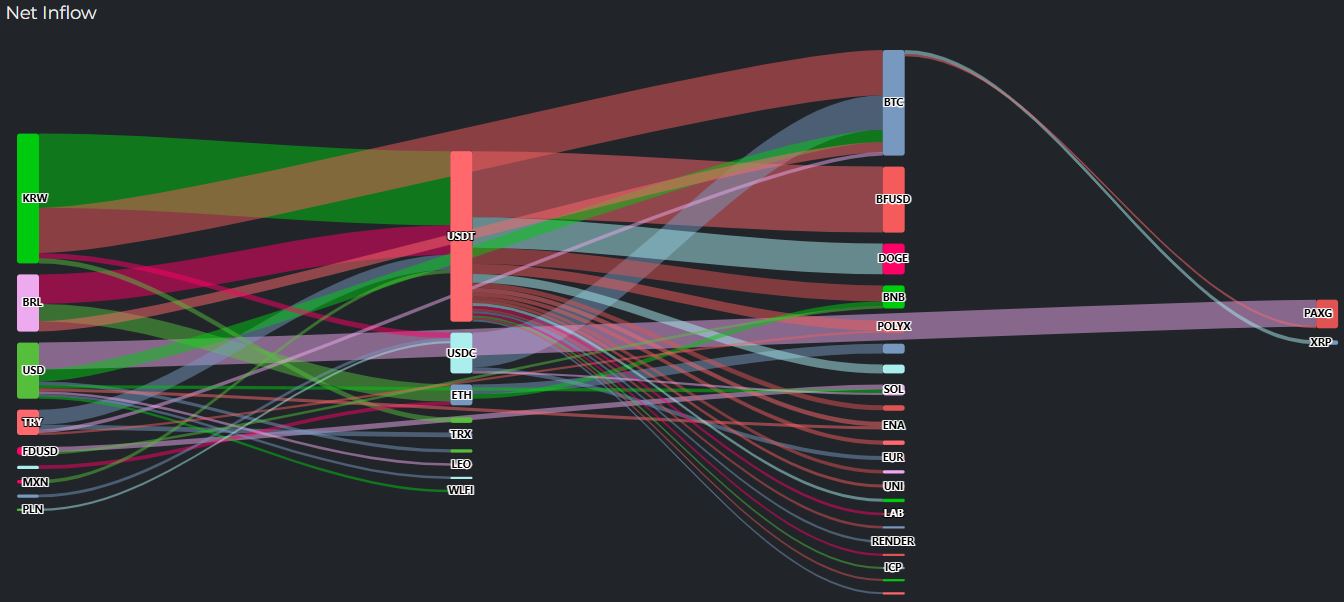
According to Cryptometer data referenced at 2:55 a.m. ET on May 15 (with flows measured over the previous five hours), fresh fiat inflows into the crypto market were led by the South Korean won (KRW) at $6.36 million, followed by the Brazilian real (BRL) at $2.80 million, the U.S. dollar (USD) at $2.76 million, and the Turkish lira (TRY) at $1.26 million.
Stablecoin flows also showed dispersion across multiple assets. Over the same window, about $8.34 million in USDT and $1.99 million in USD Coin (USDC) were distributed across various cryptocurrencies. The largest beneficiaries of these inflows were BFUSD ($5.23 million) and Bitcoin (BTC) ($5.19 million). Smaller but notable inflows were recorded in Dogecoin (DOGE) at $1.50 million, Ethereum (ETH) at $1.04 million, Pax Gold (PAXG) at $1.43 million, and BNB (BNB) at $1.15 million.
Despite those pockets of buying, the dominant story was the abrupt exit from ETH. Cryptometer¡¯s outflow dashboard showed Ethereum leading all assets with $47.27 million in net outflows over the period. Additional, more modest outflows were observed from Billions Network (BILL) at $5.26 million and Bitcoin at $4.77 million, suggesting a broader¡ªif shallow¡ªrisk reduction across several major tokens.
The destination of that withdrawn capital points to a preference for 'parking liquidity' rather than rotating immediately into other volatile assets. Cryptometer data indicated that approximately $71.39 million settled into USDT, while $14.51 million moved into USD, highlighting demand for stability and optionality amid near-term uncertainty.
In market terms, a pivot into USDT and cash-like holdings often reflects traders preparing for volatility¡ªeither to hedge drawdowns, to wait out event risk, or to keep dry powder available for faster re-entry. If the pattern persists, it may translate into thinner spot depth for major altcoins in the short run, while strengthening the role of stablecoins as the market¡¯s preferred interim settlement layer.
Article Summary by TokenPost.ai
?? Market Interpretation
- Risk-off rotation: A pronounced $47.27M net outflow from Ethereum (ETH) over ~5 hours signals short-term de-risking rather than rotation into higher-beta alts.
- Liquidity preference: Capital largely moved into USDT ($71.39M) and USD ($14.51M), suggesting traders are prioritizing stability and flexibility (¡°parking liquidity¡±).
- Mixed inflow backdrop: Despite ETH¡¯s heavy outflows, smaller inflows into BTC and select assets indicate buying was selective and likely tactical, not broad-based accumulation.
- Fiat on-ramps remain active: Fresh fiat inflows were led by KRW ($6.36M), then BRL ($2.80M), USD ($2.76M), and TRY ($1.26M), implying continued participation but with a more defensive allocation.
- Potential market impact: If the pattern continues, spot depth in major altcoins may thin, while stablecoins strengthen as the default settlement and waiting layer for redeployment.
?? Strategic Points
- Monitor ETH outflow persistence: Repeated large net outflows can precede near-term downside pressure or higher volatility; stabilization would be a constructive signal.
- Watch stablecoin dominance as a risk gauge: Rising net inflows into USDT/USD can indicate reduced risk appetite and a preference for optionality ahead of catalysts.
- Track ¡°where the inflows actually land¡±: Even in defensive regimes, BTC and liquid large caps often absorb a portion of risk capital first; continued BTC inflows alongside stablecoin buildup can hint at barbell positioning (safety + optional upside).
- Liquidity deployment signals: A large USDT build can be bullish or bearish depending on follow-through¡ªlook for subsequent conversion from USDT into majors as a confirmation of re-risking.
- Short-horizon caveat: The data reflects a ~5-hour window; treat it as an intraday positioning read, best validated with repeated intervals and price/volume confirmation.
?? Glossary
- Net inflow / net outflow: The balance of capital entering or leaving an asset over a set period (inflows minus outflows).
- Stablecoin liquidity: Capital held in stablecoins (e.g., USDT/USDC) used as a low-volatility base for trading and quick redeployment.
- Parking liquidity: Moving funds into cash-like instruments (USD or stablecoins) temporarily to reduce exposure while keeping the ability to re-enter quickly.
- Spot depth: Available buy/sell liquidity in spot order books; thinner depth can amplify price swings.
- Dry powder: Capital held on the sidelines (often in stablecoins) waiting to be deployed into risk assets.
- Event risk: Uncertainty around scheduled or unscheduled catalysts (macro releases, regulatory headlines, protocol events) that can trigger volatility.